
B2B Intent Data as a Competitive Advantage: Timing Beats Volume
Table of contents
Most B2B teams agree on one thing: intent data matters.
Where many still struggle is understanding when that intent is actually useful. Too early, and you are chasing curiosity. Too late, and the buyer has already decided — often with a competitor.
The real competitive advantage of B2B intent data is not knowing who might buy someday. It is knowing who is actively evaluating solutions right now, while the decision is still open.
The hidden flaw in lead-based intent timing
Many B2B organizations still anchor their definition of intent to a moment that feels safe and measurable: lead capture. A form fill. A demo request. A gated asset download.
The problem is not that these signals are useless. The problem iswhen they occur.
By the time a decision maker is willing to identify themselves, something important has already happened: they have formed a preference — or are very close to doing so. The buying process is no longer exploratory. It is converging.
From a competitive standpoint, this is a weak moment to first engage.
Anonymous intent is not weak intent
There is a persistent bias in B2B marketing: anonymous traffic is treated as low-value traffic. In reality, during the evaluation phase, the opposite is often true.
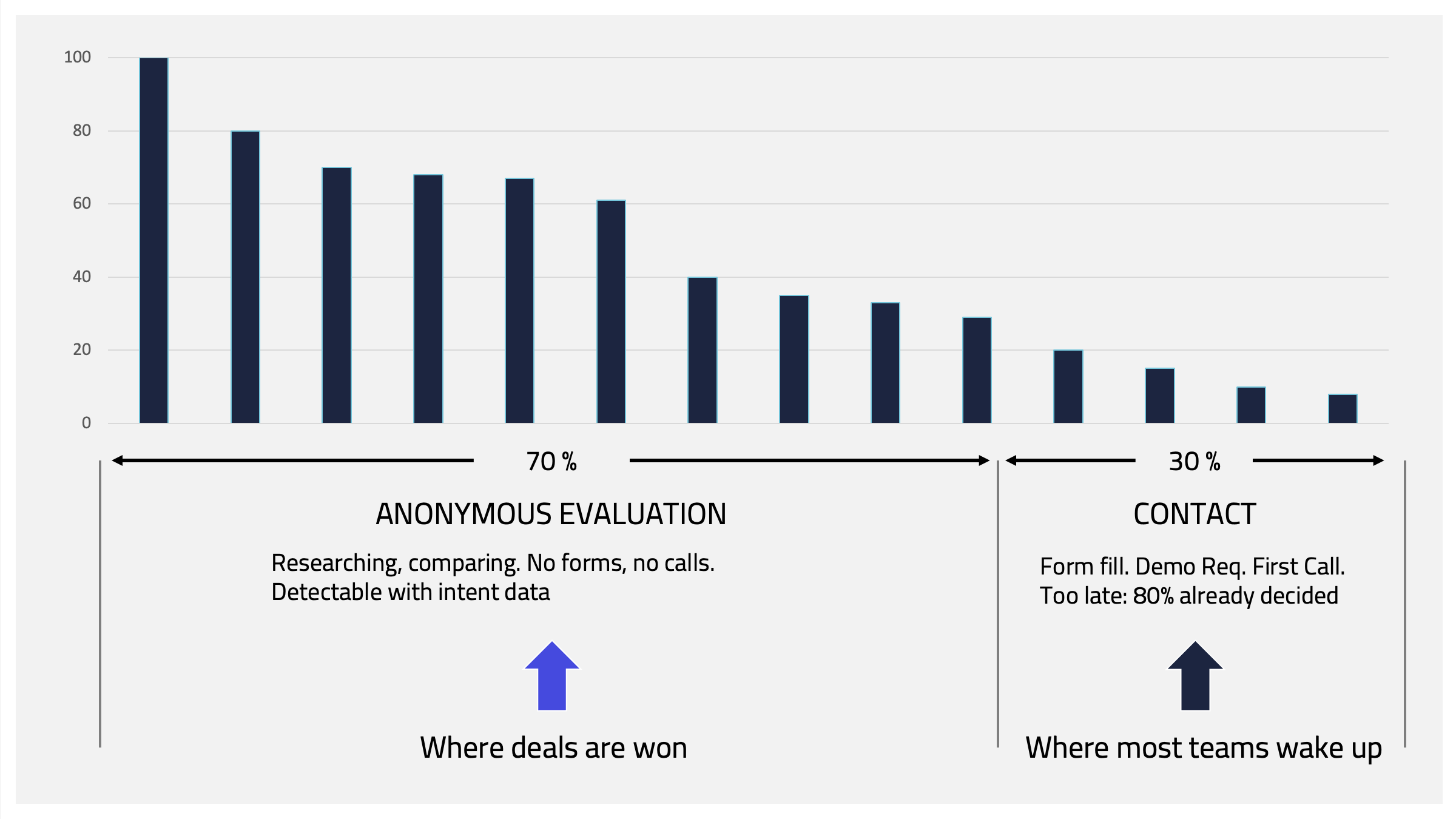
Research backs this up: according to 6sense’s 2025 Buyer Experience Report, B2B buyers are about 61% through their purchasing process before they engage with any vendor directly — and by then, 94% have already ranked their shortlist in order of preference.
When buyers are actively comparing vendors, they tend to:
- Avoid gated content
- Avoid sales conversations
- Avoid leaving identifiable signals
Not because they lack intent, but because they are protecting optionality. Remaining anonymous allows them to explore, compare, and validate without triggering pressure or follow-up.
This is precisely why some of the strongest buying signals never convert into leads.
Lead capture is a late-stage signal
Lead capture is frequently interpreted as intent, but in practice it is closer to commitment.
The same research found that 95% of the time, the winning vendor is already on the buyer’s Day One shortlist. The decision isn’t starting. It’s nearly finished.
By that stage:
- The problem is clearly defined
- A shortlist often already exists
- Internal alignment is underway
- The buyer is optimizing a final choice, not exploring alternatives
Waiting for leads means entering the process when influence is already limited. In fact, four out of five deals are won by the vendor the buyer favored before making contact. That doesn’t make a lead worthless, but by the time it happens, you’re usually validating a preference, not shaping one.
Where real intent actually shows up
The most reliable signals of active evaluation appear before identification, not after it.
They show up in website behavior — and both volume and quality matter (third-party intent data, like Bombora, is another layer entirely, worth its own discussion).
Key signals include:
- Repeated visits from the same company within a short timeframe — and even stronger: multiple different visitors from that company, signaling the interest has spread from individual curiosity to organizational consideration.
- The type of pages being browsed: product, pricing, solution-specific, integration, or technical pages indicate qualified interest in a way blog or generic content never does.
- Combination of depth and repetition: one deep visit can be curiosity; repeated deep visits point to evaluation.
- Sudden traffic spikes from a single company, often indicating parallel research by several stakeholders.
These signals won’t tell you everything — budget, internal approvals, timing. But they tell you something lead capture can’t: this company is actively evaluating solutions like yours, even if no one has identified themselves yet.
That is the moment where timing becomes a competitive advantage.
B2B Intent Data and the window of opportunity
Detecting intent before identification
Website-based company identification tools turn anonymous traffic into actionable signals. They surface the companies behind visits and reveal concrete evaluation behavior — interest in specific products, pricing pages, integrations.
The tool I use for this is Leadfeeder (full disclosure: the link I shared is an affiliate link). I recommend it because it solves precisely this problem: spotting active evaluation before buyers identify themselves.
Other tools exist in this space. What matters is the capability, not the vendor.
Real-world stories
Detecting strong purchase intent
A few years back, I was working with a local SMB in the oil sector. Typical B2B business, multiple product lines, and a small sales team.
One morning, I called one of their sellers and told him to reach out to a company he’d never heard of: a regional bus operator. The product to pitch? AdBlue solutions — a very specific part of the catalog.
He asked the obvious question: “How do you know about them?”. I told him I’d explain later. Just make the call.
He trusted me, so he did. Instead of the usual company overview, he introduced himself and went straight to AdBlue. The prospect was surprised — and interested. A week later, the seller visited their site to assess the situation. Three weeks after that, the contract was signed.
How did I know?
Leadfeeder had surfaced three visits from that company over a few days. They weren’t browsing randomly — they went straight to the AdBlue pages, read the case studies, checked the service details. The signal was clear: someone at that company was actively evaluating this exact solution.
Qualified signal. Business opportunity. Sale.
The dormant customer
I was demoing Leadfeeder to the CEO of an SMB when we spotted something unexpected: a company name he recognized immediately.
“That’s an existing client,” he said.
We pulled up their record in the ERP. Old relationship — five to ten years of history — but purchases had dropped sharply over the past 15 months. On paper, they looked like a fading account.
Back to the intent data. Over the previous three to four months, three different visitors from that company had browsed the website repeatedly. Not casual visits — they were reading solution pages, product specifications, case studies. Deep, deliberate research.
The sales team reached out.
What they discovered: the client was preparing a major expansion. Multiple new sites across the country, all requiring modernization. The project would involve significant purchases — exactly the kind of products my client sold.
None of this had surfaced through normal account management. No RFP, no inbound request, no conversation. Without that intent signal, they would have missed the opportunity entirely — or learned about it after a competitor had already engaged.
How to turn intent data into a competitive advantage
The difference between teams that have intent data and teams that benefit from it is execution.
Turning intent into advantage requires operational discipline and speed. In practice, that means:
- Filtering aggressively: exclude obvious non-buyers (careers pages, agencies, competitors, irrelevant geographies) so sales only sees signals that matter.
- Qualifying by behavior, not volume: prioritize patterns such as pricing, product, integration, or solution-specific browsing over raw visit counts.
- Acting quickly: intent decays fast. Signals should be reviewed and routed daily, not weekly.
- Distributing intelligently: route signals directly to the relevant seller or account manager, with context, instead of broadcasting generic alerts.
- Handling existing customers differently: intent from current clients often signals expansion, upsell, or churn risk — and should never be treated as net-new.
- Watching new markets: repeated visits from unexpected countries or regions often precede international expansion or partner searches. The same applies to unexpected industries.
Teams that succeed with intent data treat it as a prioritization and timing system, not a reporting layer.
Final thought
Intent data that arrives too early is noise. Intent data that arrives too late is history.
Intent data matters most when it uncovers real business opportunities, while interest is high and before the decision is made.
Ready to explore whether this approach fits your business?
Let’s talk about your specific situation — tools you already have, signals you might be missing, and what a realistic implementation looks like.
Disclosure: The Leadfeeder links in this article are affiliate links (free trial available).
Alternatives in this space include Albacross, Lead Forensics, and Clearbit Reveal. I recommend Leadfeeder because it’s what I know, use, and like — not because the others don’t work.
Statistics cited from the 6sense 2025 Buyer Experience Report.