
How CDPs Deliver Contextual Personalization in Real-Time
Table of contents
Three browser tabs open: camel wool blazer, cream cable knit cardigan, tan leather bomber. Session duration: 22 minutes. Purchase history shows dark blue jeans bought eight weeks ago. The pattern is obvious—someone’s building an outfit, mentally pairing each jacket with those jeans.
Most e-commerce sites respond with generic “Customers Also Viewed” carousels. Maybe send a discount code email tomorrow. The behavioral signal gets logged but never activated.
A Customer Data Platform (CDP) sees the same three jacket views, checks the purchase history, and triggers a banner: “Perfect matches for your dark blue jeans.” The recommendations aren’t random—they’re the exact jackets being considered, with messaging that demonstrates style intelligence, not just browsing history.
This is contextual personalization. The CDP doesn’t guess at intent or wait for batch processing. It detects high-intent patterns in real-time, applies contextual intelligence, and activates personalization while the session is still active.
What Is a CDP, Really?
If you’ve heard the term “Customer Data Platform” thrown around – or worse, sat through vendor demos promising “360-degree customer views”, you might be skeptical. Fair enough.
Here’s the straightforward definition: A CDP collects customer data from multiple sources, unifies it into individual customer profiles, and makes that data available for activation across your marketing channels.
Four parts:
- Collection: Captures behavioral data (website visits, product views, purchases), demographic data (email, location), and transactional data (order history, cart abandons) from every touchpoint
- Unification: Stitches together anonymous sessions and known customers into coherent profiles, understanding that the person who browsed on mobile Tuesday is the same person who purchased on desktop Thursday
- Intelligence: Analyzes unified profiles to identify patterns, detect intent, and determine next best actions—recognizing when three jacket views signal high purchase intent, or when cart abandonment patterns suggest price sensitivity
- Activation: Makes those unified profiles actionable in real-time—personalizing website experiences, triggering emails, customizing offers
While collection and unification are foundational plumbing, Intelligence and Activation are where CDP investments deliver returns. Intelligence transforms raw unified data into actionable decisions: who to target, when to engage, where to reach them, what to offer. Activation then executes those decisions across touchpoints.
Without Intelligence, you’re just spraying unified profiles everywhere. Without Activation, you have smart segments sitting idle. You need both to drive growth.
High-Intent Behavioral Triggers: CDP Activation in Practice
Let me show you what activation actually looks like through a specific use case: high-intent behavioral triggers.
The concept is simple: detect when visitors cross behavioral thresholds that indicate serious purchase consideration, then respond instantly with contextually relevant content.
The Business Logic:
When a customer views 3+ products in the same category during a session, that’s not browsing—that’s comparison shopping. They’re evaluating options. They’re close to a decision.
Here’s where it gets intelligent: combine that current browsing behavior with their purchase history. If someone owns dark blue jeans (historical data) and is now browsing multiple jackets (current behavior), you can respond with style-aware recommendations.
The Personalization:
A banner appears: “Perfect matches for your dark blue jeans.” It showcases jackets in complementary colors—camel, cream, tan—that pair well with what they already own. The recommendation feels curated, not algorithmic. It demonstrates understanding of both their wardrobe and how to build a cohesive look.
The system won’t recommend another dark blue jacket—that’s poor styling. It won’t show women’s jackets if they’ve only purchased men’s items—that’s poor data hygiene. It won’t trigger for anonymous visitors—that would feel invasive without context.
How the logic Flows
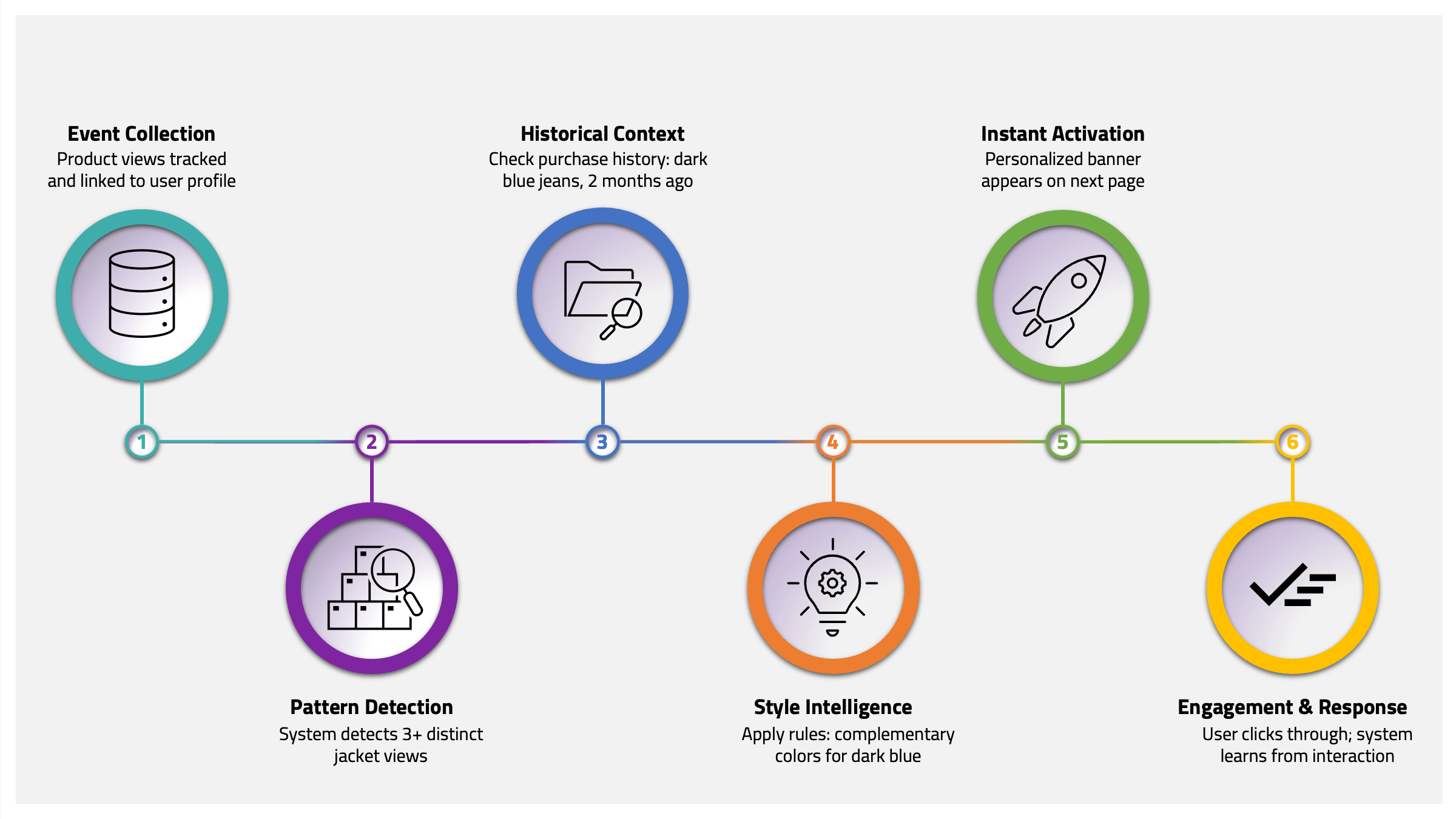
Let’s walk through what happens behind the scenes when a visitor triggers this personalization:
Step 1: Event Collection on Product Pages
Product page views fire tracking events: product ID, category, color, price, timestamp. These events flow into the CDP, building a picture of current session behavior.
Step 2: Pattern Detection
When the visitor hits their third distinct jacket view, the system recognizes the pattern. The threshold is crossed, and high purchase intent for men’s jackets is logged.
Step 3: Historical Context
The system checks: Does this customer have relevant purchase history? Yes—dark blue jeans from two months ago. That becomes the context for recommendations. The customer enters the audience that combines purchase history and browsing behavior.
Step 4: Style Intelligence
Business rules are applied: Dark blue jeans + high purchase intent for a man jacket = recommendation based on complementary colors (i.e. camel/cream/tan jackets). The logic ensures recommendations make sense from a styling perspective.
Step 5: Instant Activation
A personalized banner renders on the next product page viewed. No batch processing. No overnight ETL job. No email arriving tomorrow after they’ve already purchased from a competitor.
Step 6: Engagement & Response
The visitor clicks through to explore the recommended jackets. This engagement becomes a positive signal: the personalization was relevant and valuable. The system tracks this interaction, refining future recommendations (users who prefer not to engage can dismiss the banner with “No thanks,” which also becomes a learning signal).
Try it yourself
This isn’t theoretical. There’s a working demonstration here at lab.aoris.co where you can experience exactly this flow. To experience the personalization:
- Register below to activate the use case: it will create minimal purchase history for the use case (you will not receive any email).
- Browse three distinct men’s jackets—we’ve added jackets as related products on each jacket product page to make it easy to navigate between them. As you browse, watch how your data evolves in the CDP.
- Watch the personalized banner appear with style-matched recommendations based on the simulated purchase history. You’ll see the progress of your data on each product page.
To try this interactive demo, create a demo account. Choose any username:
Demo account only. No real email required.
The demo uses real CDP features: event tracking, behavioral analysis, automated triggers, database-driven personalization. It’s not a mockup or slideware. It’s activation in action. You’ll see personalization that feels helpful rather than creepy, timely rather than late, intelligent rather than algorithmic.
Prefer a guided tour? I’ll walk you through the live system—event capture, warehouse analysis, personalization activation—and answer your questions in real time. Book 30 minutes now.
What This Means for Your CDP Strategy
If you’re evaluating CDP platforms or trying to extract more value from one you already own, this use case demonstrates three strategic principles:
1. Activation Requires Business Logic, Not Just Data. Collecting behavioral data is table stakes. The intelligence lies in defining meaningful patterns (what threshold indicates intent?) and contextual rules (what recommendations actually make sense?). Your CDP needs to execute logic, not just store profiles.
2. Real-Time Matters for High-Intent Moments. When someone is actively shopping, the window for influence is minutes—not hours, not days. Batch segmentation and scheduled campaigns miss the moment entirely. Your CDP architecture needs to support instant activation, or you’re leaving money on the table.
3. Personalization Needs Historical + Behavioral Context. Generic “you viewed this, we recommend that” doesn’t cut it. Effective personalization combines what someone is doing right now (current behavior) with what you know about them (purchase history, preferences, past interactions). That unified profile is precisely what CDPs are supposed to deliver.
The companies seeing real ROI from CDP investments aren’t just building better data lakes. They’re building activation engines that respond intelligently to customer behavior in real-time.
What actually happened
Remember the scenario from the beginning: the customer browsing those three jackets? Here’s what the system did:
First, it detected his high-intent behavior. It cross-referenced his purchase history. It applied style logic. A personalized banner appeared suggesting the exact jackets he was already considering, positioned as perfect complements to the jeans he owns.
The visitor clicked through, added the camel blazer ($309) to the cart and checked out. Average order value: $209 instead of the $109 jeans he bought last time. Customer lifetime value is trending upward because the experience felt helpful, not pushy.
That’s what “Customer Data Platform” means when it’s actually working: collecting relevant data, unifying it into actionable profiles, and activating it for real-time, contextual personalization that drives growth.
The gap isn’t technology or data. It’s the implementation: knowing which behavioral moments matter, building the logic to detect them, and creating experiences worth triggering for the customer.
References:
[1] Insider. “Philips increases average order value by 35% with personalization.” Case study. Available at: https://useinsider.com/case-studies/philips/ (Accessed October 2025)
[2] Insider. “Adidas increased AOV by 259% and conversion rate by 13%.” Case study. Available at: https://useinsider.com/case-studies/adidas/ (Accessed October 2025)